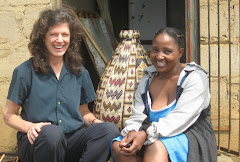
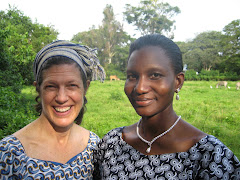
We just returned from a road trip to Sekhukuneland, a part of Limpopo Province, where we took Romeo and his Aunt Portia to see some of their family. We stayed with Romeo’s grandmother Abina, a Pedi woman in her 80s (or somewhere thereabouts, she doesn’t know her exact age). Carla and Abina’s daughter Pinky were business partners for several years, so Carla has known Abina for a long time. When Pinky died seven years ago, they were not quite finished building a house for Abina. So Carla finished the house which Pinky had designed with generous living space to accommodate the whole family and extra big courtyards and a long porch with arched, open windows. Pinky knew her mom loved living outdoors, and that’s where we found Abina the afternoon we pulled up: on her knees in the courtyard in front of her house, smoothing out a fresh layer of dung flooring to dry under the brazen sun. She has no phone so we couldn't let her know we were coming, but it seemed she had prepared for our arrival.
The village where Abina lives is called India, and the Pedi people in the area are a subdivision of the Northern Sotho tribe. India is a four-hour drive north of Johannesburg through big, open country with rolling hills and long vistas – the “high veld.” Since it’s just past winter and still early in spring, everything is dry and brown except the occasional irrigated fields.
Abina (pronounced “Ah-BEE-na”) shares her house with her daughter Anna and three grandchildren: seven-year-old Baleseng (“Bally-sing”), two-year-old Pinky, and one-year-old Ethan. Baleseng and little Pinky are Portia’s daughters, and Ethan is Romeo’s little brother. So Great Grandmother Abina and Grandmother Anna oversee a very youthful household in their home village, while Romeo lives in Soweto with his mom Tebatso who works with Carla selling Zulu baskets at a marketplace in Johannesburg.
Don’t worry about keeping all these names and relationships straight! It’s easier just to think of everybody as family, which is what Carla and I have been doing since our childhood in Wausa (where my Grandfather David and Carla’s Grandmother Elsie were brother and sister, and almost everyone in our midst was some kind of relative). Small towns in rural Africa are not so different from small towns in rural America, except maybe more like the rural Nebraska of my parents’ upbringing than my own. Every time I see an African child rolling a tire rim along with a stick, I remember my dad telling me that he did the same thing as a child inventing his own toys.
Carla has been to India many times over the years. She tried to prepare me but some things you just have to experience. Like darkness when it gets dark, and no water tap to turn on, and sitting on the porch rather than inside the house to catch what little breeze might temper the mid-day heat. I’ve been seeing these things for months now but an arm’s length away. I remember sitting in the bus riding back from Marie and Christian’s wedding in northwestern Uganda and reaching the outskirts of Kampala just as the sun was setting. The bus slowed to a crawl in the mess of city traffic just as the sky darkened and the houses and shops and stalls lining the streets lit up with candles. The activity didn’t diminish, just the daylight, as people still filled the streets and the housefronts. I’ve also seen countless people – of all ages, in all parts of Uganda and Kenya and now rural South Africa – crowded around pumps filling big, plastic, yellow (and sometimes red or blue) jerry cans. And I’ve seen women and children carrying these jugs of water on their heads, and men riding bicycles transporting more jerry cans than you’d think could fit on one bike frame.
So it’s about time I got to live some of these things myself. A few days give only a bit of an idea, but some idea is better than none.
Carla says Abina used to have a fire going most of the time in the firehouse off the side courtyard, but now she and Anna have an electric burner for cooking food. We ate cabbage and butternut squash and lots of mealie pap, the South African maize equivalent of Kenyan ugali and Ugandan posho, with a gravy made of tomatoes. Everyone sits around the courtyard to eat, and sometimes a goat walks through, finds a banana peel on the ground, and saunters out munching.
The household’s water supply was really low, so on the third day Baleseng and Romeo borrowed eight 25-liter jugs from a neighbor, and Carla drove us to the water pump (about a kilometer away) to fill the jugs. Abina, whose husband died a long time ago, used to pay a local girl to bring water periodically but now she doesn’t have enough money. Since Anna moved to India from Soweto six months ago, she has been getting the water and pushing it back in a wheelbarrow, but her hips have been bothering her lately. Carla and I and Portia and Romeo and Baleseng made a good team in carrying two loads of water – 400 liters – from the back end of Carla’s van through the courtyard and into the kitchen house where we dumped jug after jug of water into large barrels, where Anna scoops it out for cooking and washing. Ethan and Pinky, who are always fetching things for their elders, kept picking up the empty jugs and hoisting them around to help.
While we were there with a vehicle, we drove Abina to see two nieces and a grand niece and a great grand niece who live too far away to reach on foot, so Abina got to visit family and we all saw more of the valley. One day we left Portia to visit a cousin and then Carla and I and the two seven-year-olds drove back into the valley where an uncle lives by himself. He was a tall, wiry man who happily took the two naatjies (tangerines) that Baleseng gave him and let me take his photo. Then Carla drove us places where no road was visible to my eye but we found what she was looking for: a pump out in the boonies where one person can take a “shower” while someone else pumps. When we got back to Aunt Duce’s house I showed her the photo of her brother and she laughed like it was hilarious to see him.
India sits on one side of a valley where one ridge rises just behind the house and another ridge of foothills faces the house from across the wide stretch of flat land. In the evenings, we ate outside in the courtyard just as stars popped out above the ridgelines. When supper was done, Anna lit candles, and the little ones, especially Pinky, kept close by Abina’s side.
On our last day there we got up extra early to take Abina to the doctor in a nearby town. The clinic does not take appointments so people just line up and wait to see the doctor on a first-come, first-served basis. We got there about half past six on a morning that had turned cool and windy. A few people were already sitting there outside the gate, wrapped in blankets. By the time the doors opened at 8 there were about thirty people, old and young, moms with babies, and Carla and Portia and me with Abina, who waited patiently for her turn. Portia went in with her grandmother and later told Carla and me what the doctor said (Portia speaks some English as well as her mother tongue, Abina speaks only Pedi, and Carla and I speak only English).
When we left India yesterday morning we had two more passengers. We brought Ethan and Pinky back to be with their mothers, stopping first at the new SuperSpar store near India to buy some nappies (pampers) so that we wouldn’t have any accidents in the car, then driving everyone to Soweto, the huge township on the southwest edge of Jo’burg.
Now Carla and I are back in her garden flat in a neighborhood that could be mistaken for Phoenix or L.A. We each stood under a hot shower last night and today we had salads for lunch and herbal tea. I miss the laughing and crying of Ethan and Pinky, the low voices of Abina and Anna, and the cousinly banter of Baleseng and Romeo playing with the balloons from Carla and blowing bubbles at their little siblings. And I wonder how Abina will do getting around with her aching kidney and sore knee, and how she will manage without the two little ones at her side.
Thursday, September 27, 2007

Tuesday, September 18, 2007
Another Africa
I’ve been in South Africa for eight days now. Several borders and a couple weeks ago, I was still sitting in Entebbe taking a deliberate interlude, sipping a chocolate milkshake on the lawn and telling yet another inquiring waiter at the Botanical Beach Hotel, “They’ve gone back to New York, it’s just me here now.” Then I checked out and pulled my suitcase a kilometer or two down the dirt road to a more affordable place: a little, round, thatch-roofed banda tucked away in the Uganda Wildlife Education Center, which is a refuge for wildlife saved from various parts of Africa. My cottage had a gas cooker so I made my own tea, and there were two twin-size beds which made me wish my friend Marybeth were sharing the interlude with me. She would love seeing all of my animal neighbors! At night I fell asleep to strange guttural sounds, and one morning I looked out at two ostriches walking by. On the weekend I took a matatu into Kampala and stayed the night with Charlotte. How I love how she calls me Mom! She and Malko and I went to a lively church service the next morning before driving back to Entebbe, where the three of us walked all through the refuge to see the chimpanzees, rhinos, vervet monkeys, zebras, crested cranes, and one sleepy lion.
James from the wildlife refuge drove me to the Entebbe airport in 3 a.m. darkness and I flew to Nairobi and then to Johannesburg in one brief morning. Flying is efficient, but travel by road or by water is better for keeping heart and mind together. I’ve left so many hopes and friends and possibilities trailing behind me and I don’t know if that is kind or cruel. I am not responsible for the whole world but I am responsible for me. And I want to make that count.
So here I am in South Africa feeling completely at home with my cousin Carla but not yet at ease in this country that actually was home for me – 35 years ago. I lived here as an exchange student in 1972-73 when apartheid ruled and injustice was everywhere. Carla moved here in 1994 just before the historic election, which I witnessed from the states in newspaper stories about Mandela and photos of people lined up for miles to cast their first-ever vote.
I’ve wanted to return to South Africa for so long, and being welcomed by my childhood buddy is almost miraculous. But I didn’t expect the wild mix of emotions I’ve experienced since landing here last week. Initially I was stunned at the sight of so many white people, and so many nice cars – driven by both white South Africans and black South Africans – swooshing along on wide boulevards, and the absence of potholes, and manicured neighborhoods. I had a momentary emotional arrest just walking into a grocery store with Carla. It was a huge place with wide aisles and rows and rows of merchandise and bright lights that caught me like a deer in headlights (does a deer ever fight back tears?).
The wealth overwhelms me. It’s not easy reconciling the South Africa I am seeing around me and the Africa I’ve been experiencing in the last few months. First world/third world relationships are hard to rectify.
The other big set of differences – the distinctions between apartheid-era South Africa and contemporary South Africa – are stunning in other ways, hugely positive but with rough edges like crime and safety, issues that are faced by all countries of the world but did not confront South Africa in the same way when it was a police state. When I came here as an exchange student in 1972, apartheid ruled everything. Books were censored, people were banned, and benches in parks were labeled “For whites only.” Black South Africans who worked in Jo’burg either lived in servants’ quarters on white property or rode the nightly train back to Soweto or some other designated township. Schools, churches, hospitals were all separated by race, and the quality of education and care was entirely skewed.
One evening last week I went with Carla to a school here in Johannesburg to see Romeo perform in a student musical. Romeo is a 7-year-old black kid who has cerebral palsy, and Carla has helped raise him since he was born. In his classroom beforehand, Romeo and a bunch of other kids in costumes were hopping around with excitement. That all seemed normal to me. But later, in the auditorium, when the lights were dimmed and the curtains opened and kids of all colors came out on the stage, my heart did a little jump and I thought, wait a minute, where am I, is this…South Africa? I was glad it was dark in there because the tears that I’d felt rising at several odd times in those first few days just finally rolled out.
That program was so fun! All the kids – primary through middle school – had parts in a “round the world to 2010” program that was done in English and Afrikaans and pop songs and folk songs. Four girls in wheelchairs danced to Edelweiss, a bunch of boys did an African gumboot dance, and a large group of cowboys and cowgirls did a square dance when they got to the American portion, which also featured Oprah, Tom Cruise, Dolly Parton, and Paris Hilton accompanied by a guard. A troupe of Michael Jacksons performed, Elvis sang his hound dog song, and Oprah interviewed a boy dressed as the Statue of Liberty, who sang “I’ll do it my way.” Then a bunch of Marines marched in.
The best part was watching Romeo, wearing his hat and Bavarian lederhosen, dancing the folk dance he had practiced with Carla and looking perfectly at home on a stage filled with kids of all description.
So it’s a new country to get to know. I hardly recognize it. But staying with Carla feels as natural as being back in Wausa together. Her garden flat looks out to beds of flowers and vegetables surrounded by trees, and we hang clothes on the line outside to dry. But this is definitely not Kansas anymore. Or Nebraska! Nor is it quite the land that I still hope it becomes. Romeo and a whole generation may have been born after the end of apartheid, but the remnants of an old system don’t disappear overnight. And making sense of the still-strange blend of riches and crimes and cultural diversity that characterize this beautiful country may take a while.
I’d be leaving for JFK this week, according to my original schedule, and back in Alaska next week. But instead I’m staying on for October and November and some of December. Carla and I have been talking nonstop and we’ve hardly begun. There’s lots we have to do. I need to have more time in Uganda too. So a few more months will be a start.
Sunday, September 2, 2007
Crossing the border into...September?
How did it get to be September already? Equator weather confuses me. The minor changes in temperature seem like variations in an eternal summer. Yesterday, in the early morning Kitale air, David the Manor House driver had the heater going in the van as he drove me one last time to town. As the bus pulled out, I noticed that all the other passengers were wearing coats and I was the only one wearing only a short-sleeved shirt. Margaret, the head caterer at Manor House, told me that if I came back in December or January it would be hot and dusty. Not fresh and wet like a morning after a night of rain.
Tanzania will have to wait til another year or lifetime. After working like crazy to finish a newsletter for Manor House, I was finally booking a departure when my beloved Heather and Hanna emailed to say they had finished their teaching and filming a week early and were ready to head back to the U.S. So together we birthed Plan B: to converge back in Uganda, where we started two months ago. H & H flew from Dar es Salaam yesterday and I took the slower, cheaper, funner, and only way I know to get here in one day from western Kenya. A series of matatus got me here before sundown: Kitale --> Bungoma --> Malaba --> Kampala -->Entebbe. Plus a final ride on a mini-bike boda. I rode on the back (wearing my daypack) while the driver managed to keep my suitcase upright in front of his body, and he dropped me at our meeting point, a hotel near the airport where we can enjoy a couple days together.
So I found myself crossing the border at the same spot where I passed four weeks ago, and riding in the back seat with a young Kenyan going to Kampala to start school on Monday at Makerere University, sharing biscuits and bananas from my snack bag and from the vendors, and moving slowly through the crazy Kampala traffic, then so relieved to get to the shore of Lake Victoria while it was still the first day of September. H & H were here waiting for me and now we're enjoying a pause. Soon they are going and I am staying.
Last week I found out what happens when I don't get to the internet for several days. Friends start conversing on my blog! Maybe that's another reason I've come here - to connect people at home! I hope all of you who are reading my blog but not posting comments are at least READING the comments. And because I have internet access RIGHT IN MY ROOM at this moment and I want to post this note before H & H get back with our milkshakes, I'm going to respond to my commenters right here in public. Regarding the size of the world, it seems huge when you're flying from that side of the planet to this side, even though that's trotting at jet speed. It seems small once you land, anywhere, because life is here, everywhere, in both its familiar and unfamiliar guises, and it becomes shockingly obvious that we are all breathing the same air and sharing a slice of the same experience.
MY question is, how big is the world for those who live in the towns around here where travel happens by foot (or matatu), and you go only as far as you can walk, and your food feeds you as long as it's coming out of the ground, and your kids are in school now but you don't know if they will be able to continue? Or you got a bachelor's degree in social work (like the guy next to me on my last day at Royal Cybercafé) and you're still looking for work two years later? I know imagination stretches way beyond physical boundaries but how far is that? I feel like a walking lightning rod for imaginations because so many people have a deep wish to go to America and they feel one step closer when one of us shows up on their doorstep. Is the world small enough for some of them to make such a journey? I tell them how far and how expensive it is but I can only wonder how did I get here and what am I going to do about the smallness that I experience?
Abrupt subject change (but also an answer to a post by one of my favorite redheads): I didn't even notice the altitude, but then I didn't start running in Kenya until my second week there so I think my lungs had adjusted. But I also know there's a big difference between 6,000 feet and 8,000 feet. When I used to run Santa Fe trails on my visits to Marie, my running was seriously impaired by that thin mountain air (and I was never there long enough to acclimatize).
Here's something I want to tell Don and all other running enthusiasts. Turns out I WAS in Kenya running territory but didn't know it until my very last morning. I was not out there trotting along but sitting beside David going to catch that first matatu early yesterday morning when I suddenly saw a sleek, fast runner approaching - unmistakably a strong runner, with the relaxed body that belies a fast pace - and then another runner, and another. "Yeah," David said, "this is the part of Kenya that produces lots of runners." He said they "practice" most mornings, with a trainer, running the entire length of this hilly dirt road, the very one that I've been enjoying, east to the edge of town then back to some point farther west toward Mt. Elgon (my feet haven't gone more than a few kilometers in that direction). He said there are three groups - the one around here, one in West Pokot (north of here) and one south a ways - and they get together and compete, and of course many compete elsewhere in the world. "Some of them get sponsors," David said, "and they come back and buy big cars." Lightning rods come in all nationalities.
I have to finish a vanilla milkshake now. Thank you everyone for reading and posting! And I've loved getting your emails!
Friday, August 24, 2007
Gift of a week
Staying in one place and seeing the rhythm of life at Manor House has been a bonus. That may be a strange revelation for a traveler who has not exactly been rushing around. For two months now I’ve been acting less like a tourist than a relative who arrives and just moves in, or a migrant worker who finds a fitting job and claims it. Whatever I am, I’m grateful to have a week to finish some writing, to witness students going about their days, and to visit people I met during the conference who live here in Trans-Nzoia district.
The students start their day early. Some are down at the barns below the soccer field by 6:30 a.m., and later I see them in the classrooms or the gardens or the agra-forest area. Many have just returned from their three-month “attachments” – internships back in their communities or with agricultural NGOs. I’ve learned that the two-year certificate program is 40% theoretical and 60% practical, a combination that works very well.
My days have another kind of rhythm. Monday I spent with Esther and met her husband and two children. Esther is a graduate of the Manor House program and wants to establish a mini-center to train other farmers in biointensive agriculture. We decided to meet at the cybercafé and from there, she said, it would be just five minutes to her house. Apparently that’s in African time. But getting there was a treat. For the first leg we walked across a big open area and past some old rail tracks, then on a dirt route between stalls of vendors that you don’t see if you’re buzzing through town by car. That brought us close to the edge of Kitale town where taxis sit and wait. The driver Esther approached quoted a ridiculously high price (because of me, the muzungu) so I suggested we go by boda boda. So that’s how we traveled the last few kilometers. It was cheap, it was fun, and it was air conditioned. These boda bodas are not motorized mini-bikes like those back in Kampala. Here in Kitale a boda boda is a bicycle, with a big cushioned pad over the rear tire where a passenger sits and relaxes while the rider pedals like crazy up and down long hills.
Walking a kilometer or so down a dirt road after hopping off the bicycle bodas, we reached the quarter acre of land where Esther and her husband built their house just this past year. In front of the house is a large maize garden, and behind the house is a vegetable garden, carefully double dug and planted with sukuma wiki (kale) and onions and flower borders. We ate the delicious lunch Esther had made, and then we walked around her garden and took photos and talked agricultural talk. Kids from the neighborhood joined Esther’s nine-year-old Faith, who wore a Seattle Seahawks T-shirt, and four-year old Ian who ran back and forth in shyness and excitement.
Tuesday I visited Samuel’s farm but I’ll write about it later because there is only so much my heart can process at once. Wednesday I stayed “home” to get underway with the writing for Manor House. Yesterday a few details and a couple visitors punctuated my writing time, then I went into town with Emmanuel who is back from Nairobi, but we discovered that the internet was down (Kenya-wide, they told us) so we couldn’t send or receive any email. That part of the week’s pattern was already familiar.
I am back to running right at sunrise after several “lazy” mornings when I didn’t get out til 7 or so. It’s barely light at 6:30 a.m. but intensely bright by 7:30. The strange equator sun! Such a distant cousin to the northern latitude sun with its long, slow angle to the horizon. I’ve branched out from the soccer field and now run down the lane and out to the road. It’s fun to run a ways on that main dirt road and see people starting their day, on foot and on bicycle and occasionally by donkey cart or matatu.
The matatus – taxi vans – I first learned about when my daughter Heather lived in Kenya. Heather’s Nairobi mom owned one, in addition to her job with an eye care NGO. But experiencing a matatu ride is another “you haven’t lived until you’ve done it” thing. It costs 50 bob (that’s less than a U.S. dollar, let’s see, about 78 cents) for a matatu ride from Manor House into town. The ride takes fifteen minutes but the wait may be an hour or more. To maximize his income, the driver fits in as many people as possible, and that’s more than I previously imagined. Everyone squeezes even tighter to make room for one more person. Then you bump along together. As the guy next to me on one ride said, smiling, “This is Africa.”
The climate here, at least at this time of year, is incredibly nice. According to Don, who googled Kitale’s altitude for me from his computer in Kodiak, this part of Kenya is 6,200 feet above sea level. That would account for the cool mornings that lead into the deliciously warm afternoons followed by the early evening thunderclouds that build, drop rain, then disappear before the next sunrise.
It’s wet season now, a little early some people say. In fact, the rains have been so torrential not far from here that several people died when their homes were washed away. Landslides just west of us, drought to the north. This too is Africa.
A note to Jan about driving: You’re quite right about the clutch pedal. It does remain on the left, even in cars with the steering wheel on the right. Thank goodness for that! It’s surprisingly easy to steer on the right side of the car and drive on the left side of the road even after a lifetime of doing otherwise. But if the clutch and brake and gas pedals got changed around…Yikes! We would have disappeared into a pothole for sure.
Sunday, August 19, 2007
Staying on the left and having fun
What have I done for fun lately? I drove on rural Kenyan roads! Leaving the cybercafé the other day, I went to hop in the front passenger seat – and realized I’d gone by habit to the wrong side of the car. Before I could say “Oops,” Emmanuel told me it would be fine if I wanted to drive. So I had my first experience driving on the left side of the road. All the pedestrians and bicycles and other cars are a constant reminder to keep left, but Emmanuel’s Isuzu truck was another thing. He just chuckled as I learned to change gears with a shift stick on the left and to signal turns with a lever on the right. When we got out of Kitale town and onto the dirt road, the traffic disappeared but the potholes began. You haven’t lived until you’ve experienced African potholes. They’re deep and they’re everywhere. But it’s OK to drive on any side of the road or right down the middle, wherever you have the best chance of getting through. We made it back just fine!
OK, let’s see if I can do a really weak paragraph transition…or maybe an abrupt change of subject! I AM still in Kenya! And I’ve had two days to relax and just hang out with the cows and geese and the Manor House students. I was afraid it would be sad to have everybody leave at the close of the conference, and I did feel the pangs of losing new friends. But it’s rejuvenating to rest up and take sunrise runs (alas, without Jane) and sunset strolls to see the students play soccer. Tomorrow I’ll get serious about finishing up the current writing projects – and later this week I’m going to visit several people in the area who want to show me their gardens.
I used up all my air time talking with Heather and Hanna last night, but I learned they’ll be in Tanzania a little longer than I’d thought, so I can linger here this week and then find a bus or plane heading south.
I’ve been busy plopping photos into this space and hope it doesn’t slow down the page. (I can’t tell because everything here is slow.) Maybe I’ll figure out some way to attach pics so that you can see them a little bigger.
Surprise! A short blog post!
Friday, August 17, 2007
Garden of Africa
It’s August 17 and I just caught a ride into town for a cybercafé fix. Yesterday was my dad’s 82nd birthday. Happy day, Dad!! I got a ride to town yesterday too but the internet was down all over town…and now I’ve been in Kenya for TWO WEEKS and let’s see if I can get a word sent! If not, maybe I’ll have better luck in the coming week…which will take me to Tanzania where I will find two sister sojourners…H & H!!
To those of you who have shared this blog address with others, thank you! Blogging is a strange thing for a one-to-one person to be doing, but I’m not able to keep in touch as I’d like because online time is such a scarce commodity (and there’s no internet at all where I’m staying these days). I did succeed in pulling up my email account the last time I was in town, i.e., in Kitale, at a cybercafé with no coffee but lots of avid browsers. However, only a few email messages were able to load in the one hour before the cybercafé closed. The whole world may be connected but not at high speed! The IT guys here at this cybercafé have helped me as much as they possibly can. They’ve put me at a station on the outdoor balcony, let me plug in to their Cat-5 cable, configured my laptop, and pulled a canvas curtain around me to block the glare of the sun. But an email containing a couple photographs takes 30 minutes to load – if all else is going well. So patience is not an option. It’s a necessity. Maybe I’ll get lucky and the rest of my incoming emails will load…S-L-O-W-L-Y…while I’m here today.
So what am I doing in Kenya? I’m at Manor House Agricultural Centre (http://mhacbiointensive.org/) covering some events happening here. Manor House is a working farm and it’s also an agricultural college where people come to learn about biointensive agriculture, which uses methods like deep soil preparation and close spacing of plants to produce high yields even on small plots of land. It was founded in 1984 through its connection with Ecology Action, a U.S. nonprofit organization that promotes sustainable agricultural practices for small-scale farmers all over the world. Since so many people in Kenya and elsewhere in Africa grow their own food, the methods that Manor House teaches are ideal for this continent where people have limited resources but strong desire to build a future.
Last week, Manor House hosted about 140 Africans who came to meet and learn from John Jeavons, the American man who founded Ecology Action's sustainable mini-farming program and helped birth GROW BIOINTENSIVE gardening in Africa. This is the first time John has come to Africa, but it’s clear to me that the people here have loved and respected him for a long time. His weeklong workshop included theoretical sessions on topics ranging from water conservation to crop rotation, and hands-on sessions in the gardens where John and Manor House staff built a compost pile and demonstrated how to double dig the soil.
The participants – who have come from Uganda, Tanzania, Rwanda, Ethiopia, Madagascar, and Zambia as well as Kenya – are practicing farmers, teachers, community leaders, and current Manor House students. For me, they are an inspiring group of people who, along with John, are opening a window to the kind of gardening I want to do.
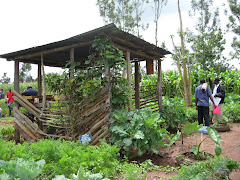
The workshop wrapped up last weekend with field trips to some of the extension centers where Manor House graduates teach people in their own villages about biointensive gardening. These places are models of community action, with gardens where maize, sorghum, and millet are grown as staples, and chard, carrots, potatoes, onions, and lots of other vegetables are grown to feed the participating families and to sell for income as well. The gardens are beautiful as well as bountiful and have become a way of life for the many people who have learned this way of growing crops. The three gardens right here at Manor House have incredibly tall maize and all kinds of other crops, some familiar to me and some – like amaranth – new. Since I grew up in corn-growing Nebraska, I love eating ears of roasted maize here in Kenya, which women vendors sell by the roadside. And I love eating the organic tomatoes and cabbage and steamed leafy greens that are served in the Manor House dining room every day.
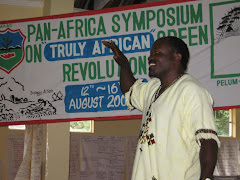
This week Manor House is hosting a Pan-Africa agriculture symposium, another big event that has kept many of the workshop participants here for a second week and brought some new participants from agriculture NGOs (non-governmental organizations) and community programs. The conference room has been packed with east Africans who are brainstorming strategies for teaching and promoting sustainable farming in Africa. In between sessions, we talk, eat, and have a lot of fun.
The goal of John Jeavons and of Manor House here in western Kenya is to teach others how to grow crops sustainably even in the face of water scarcity and reduced arable land, conditions likely to intensify in the future. Small networks of people scattered around the continent are promoting agricultural methods that work for subsistence farmers. Their commitment is palpable and they are acutely aware of the challenges. They know that chemical fertilizers and genetically modified seeds are not the long-term solution nor is reliance on outside sources. And though this part of Kenya is the granary for the rest of Kenya, many parts of Africa do not have the rainfall and fertility that bless this province.
My role here as resident writer is one of those serendipitous things. Last winter one of Marion Owen’s weekly columns in the Kodiak Daily Mirror mentioned biointensive gardening and its founder John Jeavons. I don’t know Marion well but she’s an amazing Alaskan gardener, and her column led me to google GROW BIOINTENSIVE on precisely the same day that I started my search for volunteer work in Africa. (This is what one does on dark January days on Kodiak Island.) At http://www.growbiointensive.org/, the link to international partners popped out at me. I called Marion to ask if she knew anything about the biointensive programs in Africa and she suggested I call Ecology Action in California. When I did so, they suggested I email Manor House. So last February I wrote to this place in Kenya to inquire about volunteering with gardening or whatever they needed. Nyongesa, the acting director, emailed me back (now I understand why it took a couple of weeks to hear back from him). He wrote that Manor House did take volunteers but he wasn’t sure how they could best use my skills during the time of my proposed visit. He suggested I contact them later. But by the time I left Alaska in June, I had plans to stay in Uganda after the wedding and work with the Rakai project.
I’d nearly forgotten about Manor House when an email from Nyongesa arrived during my last week at Lyantonde. He told me about their upcoming events and said they needed a writer for the purpose of producing a report and maybe a newsletter. He asked if I was still willing to volunteer.
The signs of a path dropped gently into place are unmistakable.
An early morning Akamba bus – kind of a Ugandan Greyhound – took me east out of Uganda the day after my Lyantonde students gave me a heart-warming farewell. Rather than flying into Nairobi as so many Americans do, I entered Kenya by walking across the border from Tororo to Malaba then I got back on the bus with a bunch of Africans and one other muzungu – a young guy from Minnesota. I got off at Bungoma and caught a second bus that took me to Kitale town, then a local taxi carried me over the final, bumpy ten kilometers to Manor House. Even Eddie the taxi driver told me about the beans and maize he grows!
Before leaving Uganda, I told Nyongesa on the phone that I’d like to stay right on the farm, so I’ve been in a room with a big window facing east that looks out past the clotheslines to pastures and trees and the distant rolling hills. I fall asleep to rainfall lots of nights and wake up before the sun streams in. Geese forage in the yard and hens and chicks wander everywhere. My very first morning (while eating an egg and toast and drinking fresh passion fruit juice) I saw some of the farmhands walk past the dining hall carrying chickens by their feet. Then a couple more guys carried out a cauldron that sent steam into the morning air. It reminded me of being on my grandparents’ farm when I was a little girl. Food doesn’t get any fresher than what we’ve been eating here!
Though my role is to write about what’s going on, it’s pure bonus to be learning about sustainable, organic gardening and to be meeting the people who are gathered in this spot. My new friend Anastacia is a Manor House graduate who lives in the Maasai village of Narok. Her son Ambrose is a current student here. Esther lives right in Kitale and I’ll visit her garden before I leave Kenya. Of the four people here from Uganda, Josephine runs a program in Masaka which is just an hour away from Lyantonde, and Beatrice runs a program in Kabale. Amy, a photographer from Canada, is here with John to cover the events with her camera, so I’m part of a team – with John, Amy, Nyongesa, Emmanuel, Joshua, and so many others.
My day starts early with an hour or so at my laptop and then at 6:30 I slip out of my room to head to the soccer field where I meet Jane for a run. Jane is Kenyan, and about twenty years younger than I am, and we share a love for that early morning time. We made the plan at supper one night last week and since then have shared a sunrise run every morning. I wouldn’t be out there if it weren’t for her, and she probably wouldn’t be there without me. The only other people up at that hour are the kitchen staff and a farmer called Jeph, carrying pails of milk from the barn to the kitchen, while the roosters strut around crowing and the sun lifts itself above the acacia trees.
The dining staff – a wonderful group of waiters who are here to serve the hundred or so people staying in the guesthouses and dormitories – feed us a big breakfast (and morning tea, and lunch at about 2, and afternoon tea, and supper at 8), and we are in session all day in the conference center. Some days I think my laptop will burn up from the hours of input, but all those tea breaks give my keyboard and fingers a break and keep everybody alert. Not to mention the African singing (which automatically means moving the body) that someone jumps up to lead at the start of each session.
I wish Julie, the farm manager at the Rakai project, could be here. She would have so much to share with this network of people and to receive from them as well. But it’s a tribute to Manor House that so many did make it. The donor funding that made these events possible is small by western standards, but the positive exchange happening every day is boundless. If the future can be shaped by community energy and traditional wisdom mixed in with twenty-first century savvy, the soil will still be feeding the grandchildren of the people gathered here this week. But it will take a lot of work and all the help any of us can offer.
Wednesday, August 8, 2007
Living in Lyantonde...and moving on
It is so fun to read the posts from all of you who have logged on to this blog space. Thank you for making my day! And for the personal emails too. Now, I must warn you that this posting is several pieces that I’ve combined into one…as I’ve waited a long time for an internet moment.
After three weeks here, I’m getting a feel for life in Lyantonde. I wake up early in my little room, have tea and a chapatti here at the Sunshine, walk down the dusty street to the main road then take a little path that angles through a field to the school. Every time I come and go from town, the children who live along the way yell “Muzungu! Bye, muzungu!” and I call back “Hi, how are you!” The littlest ones don’t stop waving until I’m out of sight.
One day coming home, I heard a voice from afar shout Moo..zoon..goo!!!! I was on a stretch of road that had no houses. Startled, I looked in the direction of the exuberant call and there, through the thick brush and the trees way back from the road, a skinny arm was waving.
Walking around inconspicuously is not an option for me.
It would feel strange to be so acknowledged for my skin color if it weren’t for the enthusiasm of these kids. And they’re everywhere. At the market they follow me around as I pick out a papaya (“paw paw”) from one vendor and an avocado or two from another. When I walk to the project each day I’m often joined by students, who have walked much farther than I have. One day I heard footsteps running toward me from behind and I glanced back expecting to see one of my students. Instead, it was a student from the secondary school that sits just above our vocational school. I didn’t know her but she knew who I was, and we walked the rest of the way together.
Since I’m at the vocational center most days, I eat with the students and teachers. The school day includes porridge for breakfast and posho and beans for lunch. The porridge is made from maize flour cooked in a huge cauldron over fire in an earthen kind of stove. The students (who number about 100) keep their bowls tucked away here and there. Some of the first-year tailoring girls keep their bowls and cups lined up on one of the rafters in their classroom. When the gong sounds, everyone lines up outside the small brick building where the cooking is done. We drink the porridge and sometimes have sugar in it which we “stir” by pouring the porridge back and forth between two mugs. I’ve never seen a utensil at school unless you count the huge stick that the boys use to stir the porridge. Posho is also made from maize flour except it is so thick it’s cut with a knife. One of Uganda’s staples, posho is always eaten with “sauce” – ground nut, chicken, goat meat, or peas make some of the sauces whether at someone’s home or a café. Since I rarely eat meat, I’m happy that we get beans at school (they’re kind of like a pinto bean, and they’re sorted, soaked, and cooked every day). We eat with our hands – traditional Uganda style. Tubs of water are always nearby, and we pour water into each other’s hands to wash before eating.
I enjoy these meals! I’m always hungry and so happy to go eat, unlike the students (particularly the second-year tailoring class) who often are very slow to leave their work (today they were doing zippers for the first time and they were totally intent).
The Sunshine Hotel has become my home for this moment in time. It’s a small guesthouse with eleven rooms around a courtyard with a clothesline, which Nakahima fills with the towels and sheets she washes every day (by hand, and sometimes she sings while she’s at it, and I hear her from my room). The rooms are not often occupied but the open-air restaurant in front has many customers. My room is small (about 10 ft. by 10 ft.) and modest, but I have the luxury of my own bathroom so I don’t use the “squattie potties” in back. I pay 15,000 Ugandan shillings per day to be here. That’s about $9 in U.S. currency. My space is graced by a bed and two chairs and an end table. I’ve put the tiny table in the corner to hold the reading lamp that Julie, the farm manager, loaned me, and I’ve put the chairs beside the table. A sitting area! I occasionally get visitors - Rose and Tonopah, or Nicole with young Francis from the project, though now Nicole has returned to Denmark. One day I had about eight people in this little room. Everyone enjoyed my snacks!
When I return to the Sunshine at the end of each day, I am greeted with “Kulikayo, Carol!!” (Welcome back.) The staff – Gertrude, Asiati, Zahara, Rossette, Jowelia, Nakahima, Pheonah – are very attentive and they try to teach me Luganda. When I say, “Nvudeyo!” (I’m back!) they laugh with delight that they’ve succeeded in teaching me at least one thing. They have a rambunctious rapport with each other, and they treat me with tenderness. Back when I first arrived and asked for their names, Yasin declared “We are a mixed group.” He was very pleased to be the one man on staff. They’re a diverse group in many ways. When two women first showed me to Room 7, Gertrude informed me, “I’m Catholic” and Nakahima said, “I’m Muslim.” A curious way of introducing oneself, I thought then. But other people in town have made similar disclosures, as a way of telling something significant about themselves. “I’m Protestant,” Julius told me the other day, after the umpteenth time I bought water and biscuits at his little grocery, the “Ollie & M Supermarket.” It seems Lyantonde is a cross-section of Uganda. Many folks living in harmony.
My first week in Lyantonde, I realize now, was a really good power week. We had electricity all week! Until Friday. Then we lost power and it didn’t come back in any steady fashion for the next week. When it did come back that second week, it was often a weak version of electricity, enough to light the single incandescent bulb that hangs from my bathroom ceiling but not enough to power the small fluorescent tube in the room itself. Same thing when the Sunshine would turn on its generator. The tube would just flicker but not quite light up. So I’d leave the switch off and use Julie’s little reading lamp. And candles! Many mornings I’ve wished I could pop on the headlamp I used to wear for cross-country skiing on Anchorage’s trails on dark winter evenings. That light would be perfect for working on my laptop and reading in the dark. But it never occurred to me to pack it for Africa.
After my first week here I told Don on a phone call that I had hot water. Hot water! All the time! But then the water slowed to a trickle and soon I didn’t have water at all, hot or cold. I do have water to drink because I buy 5-liter jugs from Julius’ store and sometimes smaller bottles from the restaurant here at the Sunshine. But washing myself and my clothes was a little sketchy for a few days. Gertrude brought me a 20-liter jerrycan full of water so I could flush my toilet.
Then we had a day that started out sunny and bright just like every other day except I was really irritated. Reading by candlelight in the pre-dawn hours was wearing thin. My hair was matted with dust and dirt. So I wrapped a scarf around my head and set out, walking at a fast clip along the dry roadbed before a lorry came zooming along raising those clouds of dust so awful to breathe. I went first to the office in the hope of catching an internet moment and found a computer free but alas! once again, no luck getting online. Things were just fine once I got to school though. The first year students were finishing their paper bag shirts and hanging them up on the walls. The second year students were finishing their baby dresses. The usual daylight came in through the four windows of the classroom and it got hot by mid-day and then at 2 o’clock it was weekly debate time so all the students gathered in the open-air space where assemblies are held below a high canopy roof. Two teams of four students started debating, in English, the pros and cons of family planning in Uganda, but clouds suddenly filled the sky and big splats of water started slapping the metal canopy above our heads. Rainstorm! The downpour made such a roar as it hit the canopy above us that all voices were drowned out, and those of us sitting farthest out scooted our chairs toward the center in an attempt to stay dry. Family planning went unfinished as we huddled together and watched the school yard fill with rivulets.
When I returned to the Sunshine late that afternoon (Nvudeyo! Kulikayo!), big basins were sitting all about the courtyard catching the rainwater dripping from the roof. Water to fill the taps again! I took a shower and shampooed my hair and crawled into bed clean.
Of course, my life here is luxurious. I have a room of my own and a bed with a mosquito net and a toilet that flushes. Most people in the surrounding villages have no such comforts or conveniences, though many have been helped by the community-based project that I’ve been getting to know.
One day we visited Immaculate, a 34-year-old woman who was barely alive three years ago when the project learned about her. She was taken to the HIV clinic for medical care and slowly regained her strength. Today she lives with her children in a house constructed by the project. They have beds in the house and a water tank just outside, and the children attend school. Immaculate had four children, but the oldest died of measles. She was pregnant when her husband died, and that child is now in primary school. He has been tested and does not have HIV. Getting enough to eat is still a problem for this family, and they do not have a kitchen or latrine. Immaculate looks skinny even with all the folds of her Gomez dress, but she smiles at us and thanks us for visiting and says she is feeling good. She is on ATVs (anti retroviral therapy), and Wycliff, her counselor, tells us she takes three in the morning and three in the evening. She thanked us for coming to visit, and thanked LWF for the support, and was happy to answer our questions and have Wycliff translate her words.
Her story has parallels throughout this region. Families vary in the number of children who have lived or died and whether those children have one parent left or none, or in the willingness or ability to go to the hospital to receive the medication that is available, or in the feasibility for children to stay in school when they reach secondary level which requires the payment of fees. With so much average daily suffering, the most surprising thing is the degree of resilience that exists among the people affected. The most heartening thing is the compassion shared amongst the people within these small communities, and the support offered by this project and its network of staff and volunteers.
The project – Rakai Community-Based AIDS Project – has been supported by Lutheran World Federation since 1995. LWF has been in Rakai since 1992, ten years after documentation of the first HIV/AIDS case in Uganda. At that time, the HIV rate in this region was 26%. Now it is 12%, and the stigma of the disease is decreasing along with the prevalence. The staff – the director, the counselors and social workers, and those who work in the office and farm and vocational school – are caring and competent and remarkably positive given the wide-ranging consequences of HIV/AIDS.
I’m not the only “extra” person around at the moment. Two other Americans – Rose and Tonopah – are working here too. I met both of them at Marie and Christian’s wedding, but it’s here that I’ve gotten to know them. Tonopah is a graduate of St. John’s College who is spending part of this year in Africa, and Rose is a graduate student in Public Health at Columbia. More than once, they’ve cooked dinner at the project’s guesthouse and served the rest of us delicious versions of Ugandan katogo.
Seven interns are here right now too. Doreen, Mary, Maggie, Jane, David, Justine, and John are college students from Makerere University and other colleges in Uganda. It is so fun getting to know them and seeing firsthand some of Uganda’s young generation.
Actually, everyone seems young compared to me. I think the only person older than myself around here is Francis who works on the farm (there’s also a 24-year-old Francis who works in the office). The older Francis on the farm is a wiry man with a huge smile, and he’s the first person I’ve met in Uganda who I’ve heard speaking Swahili. Because Ugandans associate Swahili with Idi Amin, under whom it was spoken, they don’t like the language. But it doesn’t matter what Francis and I speak or that we don’t understand each other’s words. He’s gotten used to having this strange white lady walking around the farm. And I love spending what little extra time I can get being on the farm with Francis and with John, the younger “casual labourer” (as he carefully spelled for me) who first gave me a complete tour of the tree nursery. On Tuesdays, all the students spend the day working on the farm, and then it’s a very busy place. On all the other days, it is very peaceful, just birdsong filling the air and sunlight filtering through the treetops.
OK…a fast forward to Wednesday, the 8th I think…If luck is with me in this cyber café in Kitale, Kenya, in the lovely western part of Kenya where the maize grows twelve feet tall… this post will actually reach ether-space. If not, I’ll try to come into town again soon (I’m staying on a wonderful farm, just east of Mount Elgon which is on the Uganda-Kenya border). In the meantime, a personal note to YOU (yes, all of you): posting a note on this blog is a better way to reach me because I am having no luck getting my GCI email account to come up on this computer, and I cannot use Outlook on my laptop because there is no wireless in a 500-kilometer radius.
Other than that, things are good and I am so happy to be here, even though it was heartwrenching to leave Lyantonde.
Subscribe to:
Posts (Atom)