Monday, November 12, 2007

Coast, Cape, and Jozi

We just returned from one last jaunt before I leave South Africa – a trip down the stretch of coast known as the Garden Route. We flew to Port Elizabeth on lowfare Kulula then rented a car and followed the curves of the Indian Ocean coastline, which winds past Jeffreys Bay, Knysna, Wilderness and one walkable beach after another. We spent many mornings and evenings walking along the surf and finding sea shells. No bellies to bury in the beach but our bare feet loved the silky sand!

We spent a couple nights in a cabin above a rocky beach at Tsitsikamma National Park, where we could sit with face to the ocean and back to a forest of indigenous trees. The trail we had planned to hike had been closed due to fire, but we figured out how to act like tourists and did little hikes and drives and explorations. One day we got harnessed up for a zipline experience, which was like hanging from high wires to zip back and forth across a river gorge.

Turns out Capetown is not the tip of Africa, as I thought when I was last here. The real southernmost point is Cape Agulhas, where a little road leads past a lighthouse to the monument marking the spot, and the waters of the Atlantic and Indian Oceans do their wild dance. On the afternoon that Carla and I reached this point, a wind was whipping up the sea and trying to blow us over. I'm sure it's a cousin of the winds that blast Kodiak Island.

In the lovely town of Hermanus, we stayed with Carla’s friends Micky and Daan (sounds like “Don”), who have a pasture for a horse called Welvaart and a huge vegetable garden covered with wire to keep the baboons out. Micky also grows old-fashioned roses of more varieties than I knew existed, and she makes incredibly fragrant potpourris. Each morning we drank rooibos tea and ate bread that Daan bakes in a woodstove. One day we took a long hike on the trails of Fernkloof, a beautiful area on the ridge above Hermanus where proteas grow profusely - whole hillsides of proteas.

Every time we drove to the seaside we saw whales. Southern right whales come to this coastline every spring to mate and calve in the protected waters down here. They feed in Antarctica during the other months. In Alaska I often have the pleasure of seeing orcas and humpbacks and belugas but usually not as close as these right whales, who lazily hang out just offshore with their babies (BIG babies), occasionally rolling or leaping or lobbing their tails.

We drove on to Capetown on a rainy afternoon, then next morning in sunshine we meandered between the coast and Table Mountain. The vistas are breathtaking, and I would love to return to do some serious hiking.

While in the Cape I reconnected with some of my South African German family – people I still love after all these years. I had corresponded with my mom Ruth for fifteen or twenty years after I lived with them in Johannesburg in 1973, but had lost contact in the last ten or fifteen years. I found Gunter, the oldest son, via a google search so I picked up the phone and found out that it was indeed the right family. So one afternoon in Paarl, just north of Capetown, Carla and I had tea with Ruth. Fun to find her looking so good and to converse about new things and old. She had moved to the Cape seven years ago after Hermann passed on. Gunter also settled in Paarl, Renate lives in Pretoria, and Harald is in Capetown.

That evening we had dinner with Gunter – a tall, handsome version of the 12-year-old boy I knew – and his wife and their two children. A big sign outside Gunter and Gisela’s home reads “Human Bean Sanctuary,” which Gisela reminded me comes from The BFG (Big Friendly Giant) – one of the many Roald Dahl books I read to Marie, Hanna, and Heather when they were small. So it was great to be human beans together around their table, and Carla did her best to occupy the two lively children while I caught up with Gunter and talked about African matters with Gisela.

From Capetown we took another Kulula flight. It felt kind of homey to get back to Jozi. Maybe I’m getting fond of this partly old, partly new city. I’m definitely becoming more adept at carrying home around inside me. And Carla has been a provocative, insightful, and protective guide to post-1994 South Africa. She has gotten to know this country more deeply than I did and has a connection that goes beyond mine. Sometimes we have feisty exchanges that alternately make me mad and challenge my thinking, like a microcosm of South African politics. Being present in this country, even for just a couple months, lets me know, again, that judging something from afar - whether positively or negatively - is easier than making sense of things close up.

It’s something of a marvel to reconnect with someone beloved from birth in a new and quite different situation. There are times when I wonder how in the heck Carla became this person I am getting to know afresh. There are other times when she seems a perfect reflection of her mom or dad, who I know so well. I have treasured this time together. We laugh so much and talk about everything, just as we did when we lived a few blocks apart on the same street where our parents still live. Carla knows how to laugh so well and it’s as contagious now as it was when we were ten.

Yesterday we went with Romeo and Tebatso to Maropeng, the Cradle of Humankind world heritage site, built into a grassy hill outside of Joburg. A wonderful place for all of us hominid descendents to visit! Tebatso tried to explain to us what maropeng means. "Home sweet home" is perhaps the closest English translation. Returning to one’s place of origin is another way to describe it. Tebatso said that walking through the displays at Maropeng made her ask questions, mostly about death. It made me ask questions too, mostly about life. And being there with Romeo was just plain fun. He picked up a drill that was part of one hands-on exhibit, probably inspired from watching Carla (earlier in the day) use the drill and other things from her bottomless toolbox to replace a broken lock at Tebatso's home in Soweto. So wonderful to have these 21st century bodies and brains. Now if we can just remember that none of us are passengers on spaceship earth (in the words of Marshall McLuhan many years ago) - We are all crew.


Just when I’m getting used to being a “we” – eating, sleeping, and laughing in the company of my new/old cousin friend – I’m soon to take off for Uganda. My youngers and elders are also in motion right now – Heather and Hanna driving from New York to San Francisco, Mom and Dad from Nebraska to Oregon. I will have one more stint in Uganda before flying to NYC where I will find one of my loving anchors (Marie!) and then by mid-December I will be back in Alaska with another loving anchor (Don!). How long I will stay put, only time will tell.

Wednesday, October 31, 2007

Altogether elsewhere

For ten days we’ve been hanging out in Johannesburg taking care of business as usual or, in Carla’s case, unusual. After several weeks of observation and intermittent participation, I’ve decided that Carla’s life fulfills the old definition of self-employment – working 100 hours a week to avoid working a 40-hour week. Some of us will do anything to remain independent and explore the deliberately thin lines between work and play!

Yesterday the play included cutting and bending the wire handles for the metal candle sculptures that Carla sells at the market. It took only one hour to get a nice blister inside the finger I used to squeeze the wire bender tool, but Carla let me know that if I want to hear about some really interesting jobs I can ask her brother about the things he has helped Carla create over the years.

Living and working with Carla also involves a lot of moving things around. From the house to the garage. From the garage to the yard. From the yard to the market with a few more times in and out of the car and garage depending on what we are making and what the weather is doing. Moving baskets from KwaZulu-Natal province to Johannesburg is just one little part.

And we’ve added a little terrier named Spotty to our day’s work and play. Spotty belongs to Carla’s friends Sue and Trevor who have gone to the states on holiday. We are housesitting so that Spotty has someone to entertain. The only real work is unlocking all the doors and gates whenever we take Spotty out for a walk. The house and garden are lovely but the security measures troublesome to one who comes from a place where I come and go without locking anything and carry only one key – to start my car. I know from what I’ve seen and heard that the security here is warranted. But it still defies common sense for me – that crime should reach such a level and that people can live with such onerous “protection.”

Political and cultural and lifestyle scenarios aside, the most basic differences that disorient me are the physical matters of time and space. I’ve gotten used to subtracting ten hours from the day before I call my sweetie, but I have to continually remind myself that the folks back at home are moving quickly into winter as I walk around under a warm spring sun. Summer will be in full blast here by Christmas time. But I don’t need to worry about being seasonally troubled then because I’ll be back in the dark and cold latitude of 60 degrees north.

Way back last June, it was strange to leave Alaska’s 18-hour days and plop down into Uganda’s equatorial twelve hours of daylight and twelve hours of dark. Now I’m getting used to other strange things, like facing north into the sun. Carla’s flat is always cool and dark because it faces south – very strange for a sun-loving, south-leaning Alaskan. I’ve also apparently been fooled by birdsong. For weeks I kept hearing a cuckoo clock and finally asked Carla, “Does Natascha have a clock that keeps cuckoo-ing?” (Natascha is the German woman who lives above us). Turns out I’m hearing the real thing – birds making their two-tone call. As if to highlight my disorder, the words to the Old English cuckoo song arrived in an email – Sumer is icumen in, lhude sing cuccu!

Traveling from the far north to the equator and then to the southern hemisphere makes one become a new learner of simple things, not just the sun’s habits but how to handle my own habits, like what food to buy from street vendors, where to exchange currency, how to load air time onto a cell phone and make a call. Each time I cross a border I learn greetings and thank yous in a new language – so many languages in Africa! Now in South Africa I am re-learning English. When I thank someone here, they do not say “You’re welcome” or “No problem” but instead just smile and say “Pleasure.”

My friend Paula in Alaska said something recently that reminded me how it’s not only hemispheres that can flip. She observed that at 25 she was working with Cambodian refugees along the Thai border, while I was starting to raise children. Now my daughters are grown and I am out doing my own volunteer work, while Paula is a new mom. Many ways to navigate through a lifetime!

It’s not just the small things of everyday existence that compel – how to phone a friend, what to eat, where to lay my head tonight. It’s the big things as well – what am I doing here, in this particular place, in this body and this life? Questions of survival and purpose come with equal urgency.

Auden’s phrase “altogether elsewhere” keeps echoing in my head. I have a sensation of being somewhere where things are all turned around or at least out of kilter, and it doesn’t feel very poetic. But it’s not always a bad thing to misread cues, mistake a bird for a clock, and feel like a foolish foreigner. It keeps my brain and heart alert and my sense of humor intact. It also keeps me present. For instance when Spotty – who has one auspicious spot – wants to play, we stop everything else and just play. And last night, at the Moonlight Market (with Spotty safely at home), I walked around in the warm night air and noticed one beautiful sight – Carla’s candles lighting up the tea garden.

Wednesday, October 17, 2007

The Swazi, Zulu, and Drakensberg circle

Roadtripping and camping with Carla is a great way to experience South Africa. We’ve just returned from an eleven-day trip that took us east to Swaziland then south into KwaZulu province and then back to Johannesburg by way of the Drakensberg Mountains.

We went to Swaziland to visit some friends of Carla’s and just to look, hike, and camp. It takes only five hours to drive from Johannesburg to Mbabane, the capital of this small, independent country – actually a Kingdom ruled by a Swazi king and his mother – located entirely within the borders of South Africa. We stayed in the Malkerns Valley at a place called Nyanza Cottages but we preferred to camp rather than stay in a cottage. We had a whole meadow with jacaranda trees and hibiscus and a view of the mountains, and peacocks wandered in and out of our area and sometimes perched in the trees above us. In the morning, as we ate papaya and Tia’s muesli with rice milk, a whole clan of vervet monkeys came into the orchard next to our campsite and watched us through the branches.

The last time we had pitched a tent together was on the Nebraska shores of Lewis & Clark Lake when we were teenagers. I’m not sure if we’ve changed much since then but our eating habits have definitely improved. In those days we kept our six-pack of Coke chilled in the lake, and if we cooked it was probably hot dogs over a fire or a Girl Scout foil pack. I also remember that it rained hard one night while the two of us were camped at Weigand and Carla suggested we dig a trench around our tent to capture the rainwater and keep ourselves dry. The trench plan didn’t work very well but we had fun digging it in the middle of the night and laughing so hard it didn’t matter that we got soaked.

Last week we spent two nights in Swaziland and both nights it rained. But we were cozy and secure in Carla’s big tent with a fly that kept us and the whole tent dry. There is nothing more wonderful than being snug in a sleeping bag and listening to rain on a tent roof. By morning the thunder and lightning and wind were finished, and the roosters and hens and chicks were crowing and pecking and running around the yard. The sun rose from behind the mountains and by afternoon it was bright and dry.

Carla’s friends told us that Swaziland was settled by people coming north from Zululand seeking a peaceful kingdom. Somehow the mountains and broad valleys exude a sense of restfulness even to one just passing through. We spent some time having coffee and seeing the art work sold at a place called Gone Rural, which markets crafts made by Swazi women and employs lots of local people in a restaurant as well. We also drove through a little game reserve, but it was so hot we just pulled over and sat back and ate our avocado and corn cakes.

The middle part of our trip was the basket buying in KwaZulu. Carla has been buying baskets from Zulu weavers since 1994 and selling them in Johannesburg. Before we ever left Jo’burg, she described the roads she drives when she makes these trips and the weavers whose work she markets. But I continually had an “ohhhh, that’s what she meant” sensation as the experience actually unfolded. She had told me there was one time when she drove to KwaZulu, bought a whole load of baskets, and drove back to Jo’burg the next day. But she said it usually takes two or three or maybe even four days. I didn’t understand how it could take that much time. In my image of the process, Carla simply made the purchases from a large group of women, like at a marketplace where everyone has gathered to sell their wares. I was soooo mistaken.

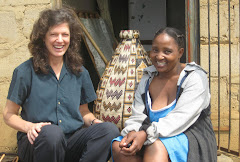
The first morning we left just after sunrise and drove an hour on a tarred highway before turning off on a little road that was scarcely discernable from a trail. When we got to a rickety set of sticks strung together with wire and stretched across the roadway, Carla stopped so I could hop out and open the gate. This brought us to the homestead of Rosalia, who came out to meet us carrying a large bulging shape wrapped in a blanket. She pulled off the blanket and handed Carla a beautiful basket, saying how much she wanted for it. They agreed on the price and Carla handed me a notebook to start recording the transactions. Rosalia also produced a basket made by a neighbor who was hoping to sell it to Carla, and a third woman showed up with some baskets she had made as well. Carla knows just enough Zulu (and Rosalia just enough English) to communicate the basics. The rest, as far as I could tell, is understood more by relationship and tone and mutual intention than by actual words.

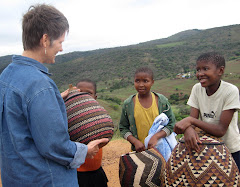
The stop at Rosalia’s was just the beginning. Later that morning we were high in the hills of KwaZulu on a clay road bed that curved alongside gullies and eucalyptus trees and ascended into thick fog that made the distant hills disappear from view. This was the one time we got stuck. We were on a steep stretch and the road was muddy from all the recent rain. But with Carla’s driving and my pushing and a bunch of sticks under the tires for traction, we managed to get unstuck. Carla called one of the weavers who has a cell phone and the word went out to find us atop this ridge. So we sat there in Carla’s Toyota Venture for about an hour before weavers began to arrive, first some young girls with their mothers’ baskets and then some older ladies and then another and another, all carrying baskets in bags and blankets atop their heads and hoisted at their sides. One by one, they showed their work to Carla. For every purchase, I wrote the weaver’s name and the size of the basket and then I counted out the payment for each happy weaver.

We finished on the third morning. In all, Carla bought enough baskets to fill every cranny in her vehicle and I met several groups of weavers who came out of the hills, literally. Wherever Carla stopped, women would emerge from distant houses. “Cahla!” they would call, as though they’d been expecting her for weeks, even if some of their baskets had long strands of ilala palm still sticking out from the rim. “Tomorrow! I will finish tomorrow. What time will you come back?” When Carla introduced me as her cousin, someone always grabbed my hand to greet me with the same triple handshake that so many east Africans use, but the Zulu names were new for me – names like Zandile, Tholi, Phindile, Thandi, and Sibongile. One girl introduced herself as Beyonce, snapping her fingers and doing a little dance move as she spelled her name for me. Carla told me it was a new name since her last trip.

Most of the time I had no idea where we were or which river we had crossed, but Carla seems to know by heart the remote, beautiful land where Zulu homesteads and gardens are scattered amongst a network of winding roads. The one route I did learn was the corridor road through Hluhluwe and Imfolozi game parks that we drove each day as we came inland from the St. Lucia wetlands where we stayed. “Keep your eyes open for wildlife,” Carla told me as we drove to the weavers. One morning a couple elephants were visible from the road, then buffalo, then impala. One late afternoon driving back we came upon five rhinos just beside the road.

We decided to spend a night in the Hluhluwe game reserve when our basket work was done, so we stayed in a rondavel at the Hilltop rest camp. That afternoon we drove leisurely through the park. It was fun to round the first bend and come upon two elephants doing some serious tree munching. We sat still and watched them reach their trunks up into one tree after another. Huge branches came crashing down, and those elephants curled their trunks around those leafy branches and scooped them up into their mouths like candy. Later, all the warthogs we came upon were skittish and ran off before we got close. We saw zebra and impala and other kinds of antelope, and guinea fowl in the low grass along the road. In the early morning as we drove slowly out of the park, several groups of giraffe were grazing near the road, and we saw more elephants and zebras as well. But my favorite sight was a dung beetle pushing its little round prize across the road right in front of us.

We drove south along the coast and buzzed right through Durban with one stop (at a great crafts place on the harbor called the Bat Centre) then we turned inland again toward the Drakensberg. I remembered this range from a trek I did in 1973 – somewhere in these mountains though I have no idea where exactly – and Carla has spent some time here too. We found a lovely campground near Cathedral Peak which we made our “base camp” for a little exploring and hiking. We had a wonderful hike to some waterfalls and a pool that reminded me of Hawaii (so of course I went in) and we also saw San Bushmen rock paintings. So exciting to find depictions of eland and hunters leaping with their bows.

So Carla is reintroducing me to South Africa and reminding me of who we are. It amazes me how she speaks like her mom at times and makes faces that look just like her dad. The same goes for me, of course. One time I made some remark and Carla exclaimed, “You sound exactly like your mom!” And then the last time we were setting up the tent, I went up to Carla with some serious comment that made her bend over with laughter. “The way you folded your hands in front of your waist when you said that! That’s exactly what Donnie does!” Hmmm, I don’t know what possessed me to take that pose, but I had to admit she had a point. My dad does stand like that sometimes. Carla and I may be on the other side of the earth but we’re still two girls from Wausa.

Friday, October 5, 2007

Foreign travel as an antidote to fear

Since arriving in Africa, I’ve been so immersed in new people and places that each time I’ve sat down to write I’ve just processed the latest experience and not said a word about overarching matters. Lately I’ve had time to catch my breath and ponder what the heck I’m doing, and I want to download thoughts on one of those global matters: fear and the traveling girl. (OK, more accurately, the older woman traveler).

Before leaving Alaska, I was astounded at the worried comments and sober admonitions I received. “Uganda?” almost everyone repeated with an appraising look. “Do be careful.” It’s hard to say whether people were assessing my sanity or their recall of African geography and events, but I did tell more than one person that Idi Amin has been gone a long time and that Uganda might in fact be an interesting place to visit.

I remember an incident from two years ago when my daughter Hanna and I drove our old Subaru from Anchorage to the east coast. Driving down the Alaska Highway late in August, we pulled into a gas station one afternoon in a little town in northern British Columbia. As the young Canadian man filled the tank, he asked us where we were going. “New York City,” I told him. His eyes flashed concern. “New York? Is it SAFE to go there?” he asked, glancing at Hanna and back at me. “Yes, it’s fine,” I told him, but he looked so dubious that I found myself explaining that millions of people live there and work and raise families and manage to survive. “I guess I’ve just seen the movies about New York,” he said. “It looks so dangerous I wouldn’t dare go there.”

He is right, of course. There are crimes and killings that happen every day in New York. And there are crimes and killings and health disasters and wars in Africa. But staying home in fear of the unknown just doesn’t make sense to me.

In the U.S., I live in the same media environment that everyone else is immersed in, and what pops into mind at the mention of Africa are the tragic things: Sudan and Darfur in particular, the terrible state of things in Zimbabwe, eruptions of violence by rebel soldiers in several regions, and so many refugees that the state of existence for many Africans seems to be in permanent flux.

My point is not that poverty and disease and danger should be ignored. My thought is that restricting knowledge to the headline news and fearing for my own safety is not a reason to stay away, or to stay ignorant, or to be fearful. Not that everyone needs to go traipsing off to remote corners of the world. Some of us have peripatetic feet and some of us are happier at home. As one who is called to wander and see for herself, I can say that the picture is so much bigger than any one of us sees and more multifaceted than the news media report.

What travel can do is inject doses of understanding into issues that seem overwhelming. It’s true that Africa has millions of children who have lost parents to HIV and AIDS. It’s uplifting to see firsthand the people and programs that are actively assisting those children. On my first day at Rakai, a counselor took us to visit a household where both parents had died in the last couple years. The counselor had just learned that the children were living there on their own. We knocked on the door and an eight-year-old boy answered. He talked to us shyly, telling us that his siblings were in school and a neighbor checked on them regularly. What struck me was not just the real face of this “child head of household” but also the counselor’s calm compassion in bringing care to this family of children.

And malaria, so big in the news, is more real than I ever imagined. People are continually getting it. Africans, that is. Like other northerners I’ve bumped into, I’m protected by the anti-malarial tablets I pop every week. Plus I usually sleep under a mosquito net. But for those born on this continent it’s a different story. Four or five people in the wedding group came down with malaria by the end of the two weeks of festivities. And Angela, the teacher I worked with at Rakai, got malaria the second week I was there. And Esther, who walked five kilometers each day to the Manor House workshop and symposium, came down with malaria after those events were over. And these are not impoverished Africans. They are people with more resilience than many others I’ve met, and they all took medicine to help them get over it and get on with life.

And refugees. Riding on the bus from northwestern Uganda back to Kampala after the wedding, we saw one IDP camp after another. (“Internally displaced persons” is the term used in Uganda and elsewhere.) Charlotte, who works with IDPs in Burundi and northern Tanzania through an NGO, told us about the UN-established camps we saw from the bus that morning after leaving Arua. “It started in 1986,” she said of the rebel activity in northern Uganda. “People run for shelter in schools or churches or wherever they can be safe.”

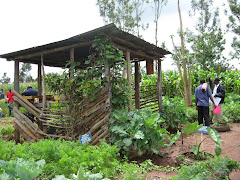
With so much suffering, it is surprising how much hope is held by so many people. Samuel, who I met in Kenya, showed me the gardens where he and two Manor House interns teach agricultural methods to farmers in the region who are beset by periodic droughts. Samuel and his wife Peris also work with women affected by HIV, teaching them gardening so they can meet their basic food needs and vocational skills so they can earn an income. Samuel and Peris have turned their living room into a resource center for their program, and they live with their two children in less space. In the yard outside, a big pile of bricks marks the place where they plan to expand their program space. They do not yet have money to build an expansion, but they have complete faith that it will happen.

I’m finding that tragedy is present in profound ways in Africa, but suffering is not the only reality. Resilience is here too, and kindness, and determination. In Uganda and Kenya I found such an entrepreneurial spirit and so much energy for building lives and livelihoods. Ugandans are especially receptive to visitors and often ask, “How do you find my country?” In Kenya I constantly heard Karibu! (welcome). In South Africa I’m still getting the feel for things. The infrastructure is leap years ahead of most countries to the north, but the political climate is testier.

As for the dangers that can beset a traveler, anyone who has experienced a theft or a mugging or a miserable experience with lodging or transportation knows that travel (whether foreign or domestic) is not always fun. If one is lucky enough to avoid serious misfortune, there is still the uncertainty of traveling where the language is unfamiliar and the cues (social, physical, or whatever) are even more undecipherable. When you can’t interpret words or faces or road signs, finding the way through a city or a situation can be difficult.

I follow my daughters’ instructions to not walk alone after dark and I take other basic precautions. I seek guidance from locals and hear their protectiveness, like the hotel staff in Kampala who told Dad and Don and my brother and me, before we exchanged our American dollars for Ugandan shillings, “Watch out, there are thieves everywhere.” And I file away Carla’s safeguards, like never leaving a car parked on the street in this city. But my idea of travel is not exactly the mainstream model. I choose safety but not luxury, and I’ll take adventure and economy over comfort and speed. I travel to learn more than anything else.

Most of all I follow my instincts about what to do and what not to do. A solo traveler has to be in tune with herself as well as the world around her, not just for safety but for the fullest experience. Traveling solo at 18 was a great introduction to the world. Traveling at 53 is even better. I get fewer passes and more respect, and I love how everyone from Kampala to Kitale to Johannesburg calls me Mama.

It is sad that people in the U.S. hear the worst about Africa and often fear the rest. The fact is, what I’ve experienced here is warmth, community spirit, human kindness, and a desire to make life better. Being here for this blink of time brings me close to what I regard as important – living consciously, having a real idea of how we are connected to each other, and seeing how each of us matters.

OK, enough musing! Tomorrow Carla and I leave for Swaziland and KwaZulu province. So now we need to pack for the road. But one more thing! October 8 is coming soon and I may be far removed from an internet connection so here’s an early HAPPY BIRTHDAY, MOM! 76 – woohoo!

Thursday, September 27, 2007

A village in Africa called India

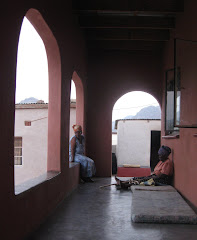
We just returned from a road trip to Sekhukuneland, a part of Limpopo Province, where we took Romeo and his Aunt Portia to see some of their family. We stayed with Romeo’s grandmother Abina, a Pedi woman in her 80s (or somewhere thereabouts, she doesn’t know her exact age). Carla and Abina’s daughter Pinky were business partners for several years, so Carla has known Abina for a long time. When Pinky died seven years ago, they were not quite finished building a house for Abina. So Carla finished the house which Pinky had designed with generous living space to accommodate the whole family and extra big courtyards and a long porch with arched, open windows. Pinky knew her mom loved living outdoors, and that’s where we found Abina the afternoon we pulled up: on her knees in the courtyard in front of her house, smoothing out a fresh layer of dung flooring to dry under the brazen sun. She has no phone so we couldn't let her know we were coming, but it seemed she had prepared for our arrival.

The village where Abina lives is called India, and the Pedi people in the area are a subdivision of the Northern Sotho tribe. India is a four-hour drive north of Johannesburg through big, open country with rolling hills and long vistas – the “high veld.” Since it’s just past winter and still early in spring, everything is dry and brown except the occasional irrigated fields.

Abina (pronounced “Ah-BEE-na”) shares her house with her daughter Anna and three grandchildren: seven-year-old Baleseng (“Bally-sing”), two-year-old Pinky, and one-year-old Ethan. Baleseng and little Pinky are Portia’s daughters, and Ethan is Romeo’s little brother. So Great Grandmother Abina and Grandmother Anna oversee a very youthful household in their home village, while Romeo lives in Soweto with his mom Tebatso who works with Carla selling Zulu baskets at a marketplace in Johannesburg.

Don’t worry about keeping all these names and relationships straight! It’s easier just to think of everybody as family, which is what Carla and I have been doing since our childhood in Wausa (where my Grandfather David and Carla’s Grandmother Elsie were brother and sister, and almost everyone in our midst was some kind of relative). Small towns in rural Africa are not so different from small towns in rural America, except maybe more like the rural Nebraska of my parents’ upbringing than my own. Every time I see an African child rolling a tire rim along with a stick, I remember my dad telling me that he did the same thing as a child inventing his own toys.

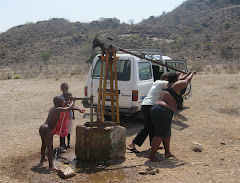
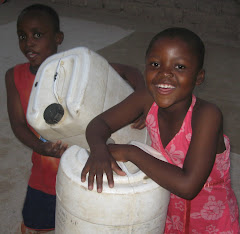
Carla has been to India many times over the years. She tried to prepare me but some things you just have to experience. Like darkness when it gets dark, and no water tap to turn on, and sitting on the porch rather than inside the house to catch what little breeze might temper the mid-day heat. I’ve been seeing these things for months now but an arm’s length away. I remember sitting in the bus riding back from Marie and Christian’s wedding in northwestern Uganda and reaching the outskirts of Kampala just as the sun was setting. The bus slowed to a crawl in the mess of city traffic just as the sky darkened and the houses and shops and stalls lining the streets lit up with candles. The activity didn’t diminish, just the daylight, as people still filled the streets and the housefronts. I’ve also seen countless people – of all ages, in all parts of Uganda and Kenya and now rural South Africa – crowded around pumps filling big, plastic, yellow (and sometimes red or blue) jerry cans. And I’ve seen women and children carrying these jugs of water on their heads, and men riding bicycles transporting more jerry cans than you’d think could fit on one bike frame.

So it’s about time I got to live some of these things myself. A few days give only a bit of an idea, but some idea is better than none.

Carla says Abina used to have a fire going most of the time in the firehouse off the side courtyard, but now she and Anna have an electric burner for cooking food. We ate cabbage and butternut squash and lots of mealie pap, the South African maize equivalent of Kenyan ugali and Ugandan posho, with a gravy made of tomatoes. Everyone sits around the courtyard to eat, and sometimes a goat walks through, finds a banana peel on the ground, and saunters out munching.

The household’s water supply was really low, so on the third day Baleseng and Romeo borrowed eight 25-liter jugs from a neighbor, and Carla drove us to the water pump (about a kilometer away) to fill the jugs. Abina, whose husband died a long time ago, used to pay a local girl to bring water periodically but now she doesn’t have enough money. Since Anna moved to India from Soweto six months ago, she has been getting the water and pushing it back in a wheelbarrow, but her hips have been bothering her lately. Carla and I and Portia and Romeo and Baleseng made a good team in carrying two loads of water – 400 liters – from the back end of Carla’s van through the courtyard and into the kitchen house where we dumped jug after jug of water into large barrels, where Anna scoops it out for cooking and washing. Ethan and Pinky, who are always fetching things for their elders, kept picking up the empty jugs and hoisting them around to help.

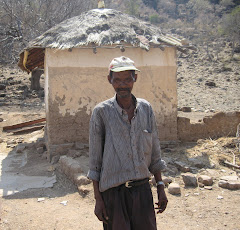
While we were there with a vehicle, we drove Abina to see two nieces and a grand niece and a great grand niece who live too far away to reach on foot, so Abina got to visit family and we all saw more of the valley. One day we left Portia to visit a cousin and then Carla and I and the two seven-year-olds drove back into the valley where an uncle lives by himself. He was a tall, wiry man who happily took the two naatjies (tangerines) that Baleseng gave him and let me take his photo. Then Carla drove us places where no road was visible to my eye but we found what she was looking for: a pump out in the boonies where one person can take a “shower” while someone else pumps. When we got back to Aunt Duce’s house I showed her the photo of her brother and she laughed like it was hilarious to see him.

India sits on one side of a valley where one ridge rises just behind the house and another ridge of foothills faces the house from across the wide stretch of flat land. In the evenings, we ate outside in the courtyard just as stars popped out above the ridgelines. When supper was done, Anna lit candles, and the little ones, especially Pinky, kept close by Abina’s side.

On our last day there we got up extra early to take Abina to the doctor in a nearby town. The clinic does not take appointments so people just line up and wait to see the doctor on a first-come, first-served basis. We got there about half past six on a morning that had turned cool and windy. A few people were already sitting there outside the gate, wrapped in blankets. By the time the doors opened at 8 there were about thirty people, old and young, moms with babies, and Carla and Portia and me with Abina, who waited patiently for her turn. Portia went in with her grandmother and later told Carla and me what the doctor said (Portia speaks some English as well as her mother tongue, Abina speaks only Pedi, and Carla and I speak only English).

When we left India yesterday morning we had two more passengers. We brought Ethan and Pinky back to be with their mothers, stopping first at the new SuperSpar store near India to buy some nappies (pampers) so that we wouldn’t have any accidents in the car, then driving everyone to Soweto, the huge township on the southwest edge of Jo’burg.

Now Carla and I are back in her garden flat in a neighborhood that could be mistaken for Phoenix or L.A. We each stood under a hot shower last night and today we had salads for lunch and herbal tea. I miss the laughing and crying of Ethan and Pinky, the low voices of Abina and Anna, and the cousinly banter of Baleseng and Romeo playing with the balloons from Carla and blowing bubbles at their little siblings. And I wonder how Abina will do getting around with her aching kidney and sore knee, and how she will manage without the two little ones at her side.

Tuesday, September 18, 2007

Another Africa

I’ve been in South Africa for eight days now. Several borders and a couple weeks ago, I was still sitting in Entebbe taking a deliberate interlude, sipping a chocolate milkshake on the lawn and telling yet another inquiring waiter at the Botanical Beach Hotel, “They’ve gone back to New York, it’s just me here now.” Then I checked out and pulled my suitcase a kilometer or two down the dirt road to a more affordable place: a little, round, thatch-roofed banda tucked away in the Uganda Wildlife Education Center, which is a refuge for wildlife saved from various parts of Africa. My cottage had a gas cooker so I made my own tea, and there were two twin-size beds which made me wish my friend Marybeth were sharing the interlude with me. She would love seeing all of my animal neighbors! At night I fell asleep to strange guttural sounds, and one morning I looked out at two ostriches walking by. On the weekend I took a matatu into Kampala and stayed the night with Charlotte. How I love how she calls me Mom! She and Malko and I went to a lively church service the next morning before driving back to Entebbe, where the three of us walked all through the refuge to see the chimpanzees, rhinos, vervet monkeys, zebras, crested cranes, and one sleepy lion.

James from the wildlife refuge drove me to the Entebbe airport in 3 a.m. darkness and I flew to Nairobi and then to Johannesburg in one brief morning. Flying is efficient, but travel by road or by water is better for keeping heart and mind together. I’ve left so many hopes and friends and possibilities trailing behind me and I don’t know if that is kind or cruel. I am not responsible for the whole world but I am responsible for me. And I want to make that count.

So here I am in South Africa feeling completely at home with my cousin Carla but not yet at ease in this country that actually was home for me – 35 years ago. I lived here as an exchange student in 1972-73 when apartheid ruled and injustice was everywhere. Carla moved here in 1994 just before the historic election, which I witnessed from the states in newspaper stories about Mandela and photos of people lined up for miles to cast their first-ever vote.

I’ve wanted to return to South Africa for so long, and being welcomed by my childhood buddy is almost miraculous. But I didn’t expect the wild mix of emotions I’ve experienced since landing here last week. Initially I was stunned at the sight of so many white people, and so many nice cars – driven by both white South Africans and black South Africans – swooshing along on wide boulevards, and the absence of potholes, and manicured neighborhoods. I had a momentary emotional arrest just walking into a grocery store with Carla. It was a huge place with wide aisles and rows and rows of merchandise and bright lights that caught me like a deer in headlights (does a deer ever fight back tears?).

The wealth overwhelms me. It’s not easy reconciling the South Africa I am seeing around me and the Africa I’ve been experiencing in the last few months. First world/third world relationships are hard to rectify.

The other big set of differences – the distinctions between apartheid-era South Africa and contemporary South Africa – are stunning in other ways, hugely positive but with rough edges like crime and safety, issues that are faced by all countries of the world but did not confront South Africa in the same way when it was a police state. When I came here as an exchange student in 1972, apartheid ruled everything. Books were censored, people were banned, and benches in parks were labeled “For whites only.” Black South Africans who worked in Jo’burg either lived in servants’ quarters on white property or rode the nightly train back to Soweto or some other designated township. Schools, churches, hospitals were all separated by race, and the quality of education and care was entirely skewed.

One evening last week I went with Carla to a school here in Johannesburg to see Romeo perform in a student musical. Romeo is a 7-year-old black kid who has cerebral palsy, and Carla has helped raise him since he was born. In his classroom beforehand, Romeo and a bunch of other kids in costumes were hopping around with excitement. That all seemed normal to me. But later, in the auditorium, when the lights were dimmed and the curtains opened and kids of all colors came out on the stage, my heart did a little jump and I thought, wait a minute, where am I, is this…South Africa? I was glad it was dark in there because the tears that I’d felt rising at several odd times in those first few days just finally rolled out.

That program was so fun! All the kids – primary through middle school – had parts in a “round the world to 2010” program that was done in English and Afrikaans and pop songs and folk songs. Four girls in wheelchairs danced to Edelweiss, a bunch of boys did an African gumboot dance, and a large group of cowboys and cowgirls did a square dance when they got to the American portion, which also featured Oprah, Tom Cruise, Dolly Parton, and Paris Hilton accompanied by a guard. A troupe of Michael Jacksons performed, Elvis sang his hound dog song, and Oprah interviewed a boy dressed as the Statue of Liberty, who sang “I’ll do it my way.” Then a bunch of Marines marched in.

The best part was watching Romeo, wearing his hat and Bavarian lederhosen, dancing the folk dance he had practiced with Carla and looking perfectly at home on a stage filled with kids of all description.

So it’s a new country to get to know. I hardly recognize it. But staying with Carla feels as natural as being back in Wausa together. Her garden flat looks out to beds of flowers and vegetables surrounded by trees, and we hang clothes on the line outside to dry. But this is definitely not Kansas anymore. Or Nebraska! Nor is it quite the land that I still hope it becomes. Romeo and a whole generation may have been born after the end of apartheid, but the remnants of an old system don’t disappear overnight. And making sense of the still-strange blend of riches and crimes and cultural diversity that characterize this beautiful country may take a while.

I’d be leaving for JFK this week, according to my original schedule, and back in Alaska next week. But instead I’m staying on for October and November and some of December. Carla and I have been talking nonstop and we’ve hardly begun. There’s lots we have to do. I need to have more time in Uganda too. So a few more months will be a start.

Sunday, September 2, 2007

Crossing the border into...September?

How did it get to be September already? Equator weather confuses me. The minor changes in temperature seem like variations in an eternal summer. Yesterday, in the early morning Kitale air, David the Manor House driver had the heater going in the van as he drove me one last time to town. As the bus pulled out, I noticed that all the other passengers were wearing coats and I was the only one wearing only a short-sleeved shirt. Margaret, the head caterer at Manor House, told me that if I came back in December or January it would be hot and dusty. Not fresh and wet like a morning after a night of rain.

Tanzania will have to wait til another year or lifetime. After working like crazy to finish a newsletter for Manor House, I was finally booking a departure when my beloved Heather and Hanna emailed to say they had finished their teaching and filming a week early and were ready to head back to the U.S. So together we birthed Plan B: to converge back in Uganda, where we started two months ago. H & H flew from Dar es Salaam yesterday and I took the slower, cheaper, funner, and only way I know to get here in one day from western Kenya. A series of matatus got me here before sundown: Kitale --> Bungoma --> Malaba --> Kampala -->Entebbe. Plus a final ride on a mini-bike boda. I rode on the back (wearing my daypack) while the driver managed to keep my suitcase upright in front of his body, and he dropped me at our meeting point, a hotel near the airport where we can enjoy a couple days together.

So I found myself crossing the border at the same spot where I passed four weeks ago, and riding in the back seat with a young Kenyan going to Kampala to start school on Monday at Makerere University, sharing biscuits and bananas from my snack bag and from the vendors, and moving slowly through the crazy Kampala traffic, then so relieved to get to the shore of Lake Victoria while it was still the first day of September. H & H were here waiting for me and now we're enjoying a pause. Soon they are going and I am staying.

Last week I found out what happens when I don't get to the internet for several days. Friends start conversing on my blog! Maybe that's another reason I've come here - to connect people at home! I hope all of you who are reading my blog but not posting comments are at least READING the comments. And because I have internet access RIGHT IN MY ROOM at this moment and I want to post this note before H & H get back with our milkshakes, I'm going to respond to my commenters right here in public. Regarding the size of the world, it seems huge when you're flying from that side of the planet to this side, even though that's trotting at jet speed. It seems small once you land, anywhere, because life is here, everywhere, in both its familiar and unfamiliar guises, and it becomes shockingly obvious that we are all breathing the same air and sharing a slice of the same experience.

MY question is, how big is the world for those who live in the towns around here where travel happens by foot (or matatu), and you go only as far as you can walk, and your food feeds you as long as it's coming out of the ground, and your kids are in school now but you don't know if they will be able to continue? Or you got a bachelor's degree in social work (like the guy next to me on my last day at Royal Cybercafé) and you're still looking for work two years later? I know imagination stretches way beyond physical boundaries but how far is that? I feel like a walking lightning rod for imaginations because so many people have a deep wish to go to America and they feel one step closer when one of us shows up on their doorstep. Is the world small enough for some of them to make such a journey? I tell them how far and how expensive it is but I can only wonder how did I get here and what am I going to do about the smallness that I experience?

Abrupt subject change (but also an answer to a post by one of my favorite redheads): I didn't even notice the altitude, but then I didn't start running in Kenya until my second week there so I think my lungs had adjusted. But I also know there's a big difference between 6,000 feet and 8,000 feet. When I used to run Santa Fe trails on my visits to Marie, my running was seriously impaired by that thin mountain air (and I was never there long enough to acclimatize).

Here's something I want to tell Don and all other running enthusiasts. Turns out I WAS in Kenya running territory but didn't know it until my very last morning. I was not out there trotting along but sitting beside David going to catch that first matatu early yesterday morning when I suddenly saw a sleek, fast runner approaching - unmistakably a strong runner, with the relaxed body that belies a fast pace - and then another runner, and another. "Yeah," David said, "this is the part of Kenya that produces lots of runners." He said they "practice" most mornings, with a trainer, running the entire length of this hilly dirt road, the very one that I've been enjoying, east to the edge of town then back to some point farther west toward Mt. Elgon (my feet haven't gone more than a few kilometers in that direction). He said there are three groups - the one around here, one in West Pokot (north of here) and one south a ways - and they get together and compete, and of course many compete elsewhere in the world. "Some of them get sponsors," David said, "and they come back and buy big cars." Lightning rods come in all nationalities.

I have to finish a vanilla milkshake now. Thank you everyone for reading and posting! And I've loved getting your emails!